
 Sign up
Price
Local prices and currencies
Compare visible prices, currency conversion, local taxes, fees, and market-specific price changes.
Track public prices across markets where location changes what buyers see.
Regional price monitoring helps ecommerce, travel, SaaS, and marketplace teams compare how prices, currencies, discounts, shipping, and availability vary by country or city. Proxies provide the location control needed to collect public pricing data from the same markets your customers and competitors operate in.
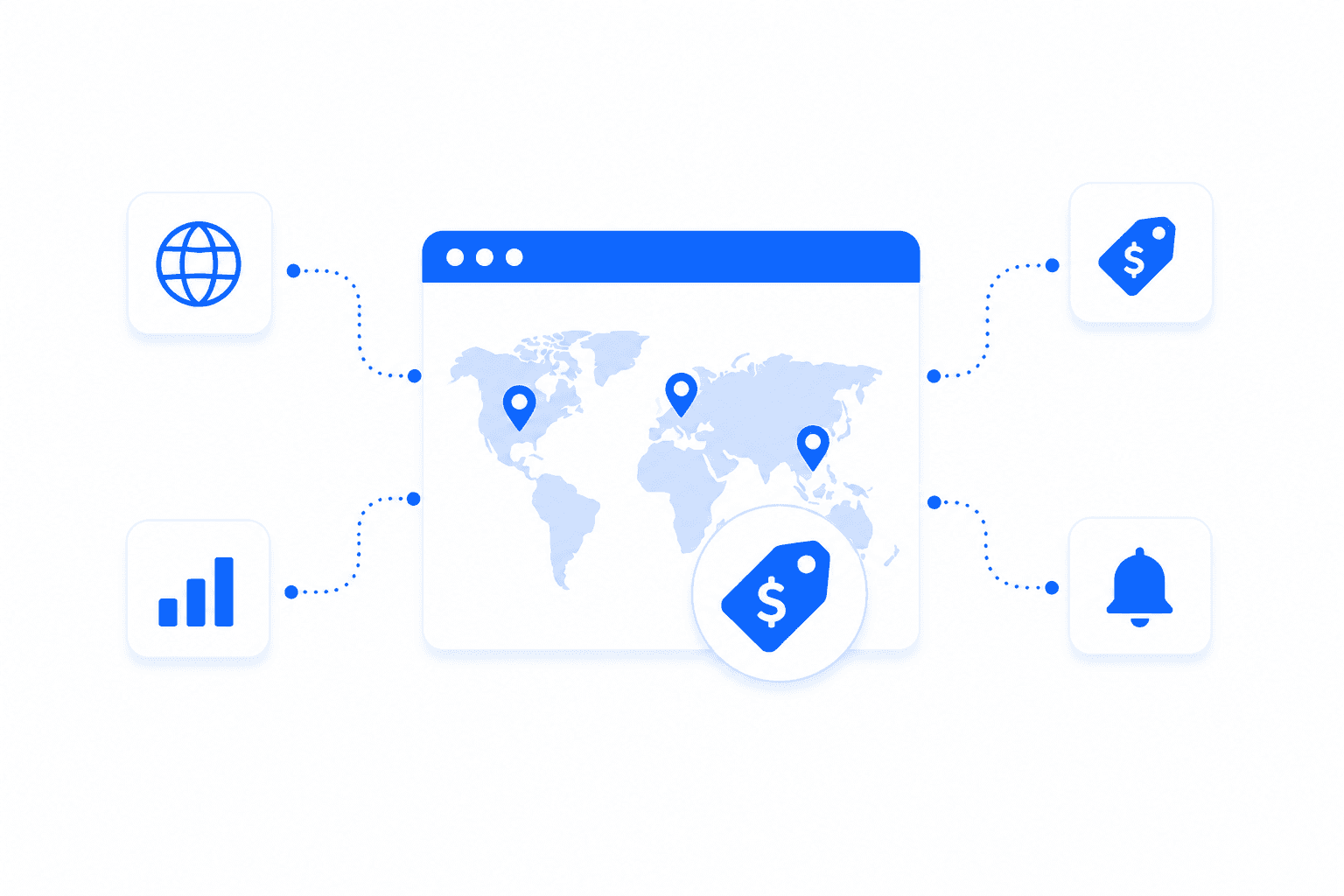
Regional price monitoring is the process of checking public prices from different locations to understand market-specific pricing behavior. Websites may show different currencies, discounts, fees, taxes, shipping options, stock states, or product availability depending on a visitor's IP location. Geo-targeted proxies help teams collect those localized price signals consistently.
Localized price monitoring usually combines price, availability, delivery, and offer signals.
Compare visible prices, currency conversion, local taxes, fees, and market-specific price changes.
Track coupons, regional promotions, member offers, campaign prices, and limited-time deals.
Monitor whether products, plans, tickets, rooms, or services are available in each target market.
Check delivery fees, estimated arrival dates, store pickup options, and local fulfillment rules.
Proxies let price monitoring systems request pages from specific markets and compare localized price outputs. Sticky sessions help preserve carts and location settings, while rotating sessions help cover many products, categories, sellers, or competitors without relying on one visible IP.
Collect prices as users see them in selected countries, regions, or cities.
Track how competitors adjust prices, promotions, shipping, and availability by market.
Run scheduled checks to identify regional price changes, stock shifts, and offer timing.
Use proxies with browser automation, ecommerce crawlers, APIs, or internal pricing tools.
Choose products, competitors, and target markets.
Route checks through matching geo-targeted proxies.
Collect prices, currencies, promotions, shipping, and stock signals.
Normalize results for pricing dashboards, alerts, or market analysis.
Regional price monitoring usually needs realistic consumer IPs and broad location coverage.
Residential proxies are the best default because they provide realistic local access for ecommerce, marketplace, travel, and public pricing pages that personalize by location.
Useful for fast checks on sources that do not block datacenter traffic or heavily personalize by IP type.
Best forBest when pricing differs on mobile-first platforms, app flows, or cellular-style traffic.
Best forGood for repeatable checks against allowlisted partners or stable pricing endpoints.
Best forGeo-targeted proxies are proxies that let you route traffic through IP addresses from specific countries, regions, cities, ISPs, or networks. They are used to test localized content, collect regional data, check pricing, verify ads, and compare website behavior across markets. Geo proxies are important when websites change content based on user location.
Businesses use proxies for localization testing to see how websites, apps, ads, pricing, currencies, language, and redirects appear in different regions. Testing from only one office IP can miss local bugs or incorrect regional content. Geo-targeted proxies help QA and marketing teams verify the real user experience in target markets.
Yes. Proxies can help access regional website versions by making the request appear from a specific country or city. This is useful for checking local landing pages, regional catalogs, content availability, search results, and market-specific offers. Access still depends on the website's own rules and detection systems.
The best proxies for geo testing are usually residential proxies with strong country, region, and city targeting. Residential IPs often provide a more realistic local user signal than datacenter IPs. For basic checks, datacenter proxies can work, but residential proxies are usually better for sensitive localization tests.
Yes. Geo-targeted proxies can help check prices in different countries, currencies, delivery regions, and local markets. Many websites adjust prices based on user location, taxes, shipping availability, or regional promotions. Proxies help teams compare pricing data more accurately across locations.
Yes. Geo proxies can be used to test local search results, map packs, localized SERPs, regional ads, and market-specific snippets. Search engines often change results based on location and language, so geo-targeted proxies help measure local visibility. This is useful for SEO agencies, local businesses, and market research teams.
Proxies help app localization QA by letting testers check regional content, API responses, redirects, pricing, language, and access behavior from different markets. They can be combined with device emulators, real devices, or browser testing tools. This helps catch bugs that only appear in certain countries or regions.
Country targeting routes traffic through an IP address in a selected country, while city targeting narrows the proxy location to a specific city or metro area when available. City targeting is useful for local SEO, regional ads, delivery checks, and hyperlocal content testing. Country targeting is enough for broader market checks.
No. Geo-targeted proxies do not guarantee that every website will detect the IP location exactly the same way. Different GeoIP databases update at different times and may classify the same IP differently. For serious geo testing, results should be checked against the target platform, not only generic IP lookup tools.
For localization projects, residential proxies are usually the best choice because they provide realistic local IP addresses and flexible geo-targeting. Datacenter proxies may be enough for basic page checks, but they can be less reliable on protected websites. The best setup depends on the target market, website sensitivity, and required location precision.
Use Proxxxymiron proxies to collect localized prices, offers, availability, and market signals from public websites.