
 Sign up
Prices
Current product prices
Collect listed prices, sale prices, currency differences, and regional price variations.
Track ecommerce prices across locations, marketplaces, and product pages without relying on one visible IP.
Price monitoring workflows collect public price, discount, shipping, and availability signals from many retail pages. Proxies help distribute requests, select locations, and keep recurring checks stable when websites personalize prices by country, region, or session.
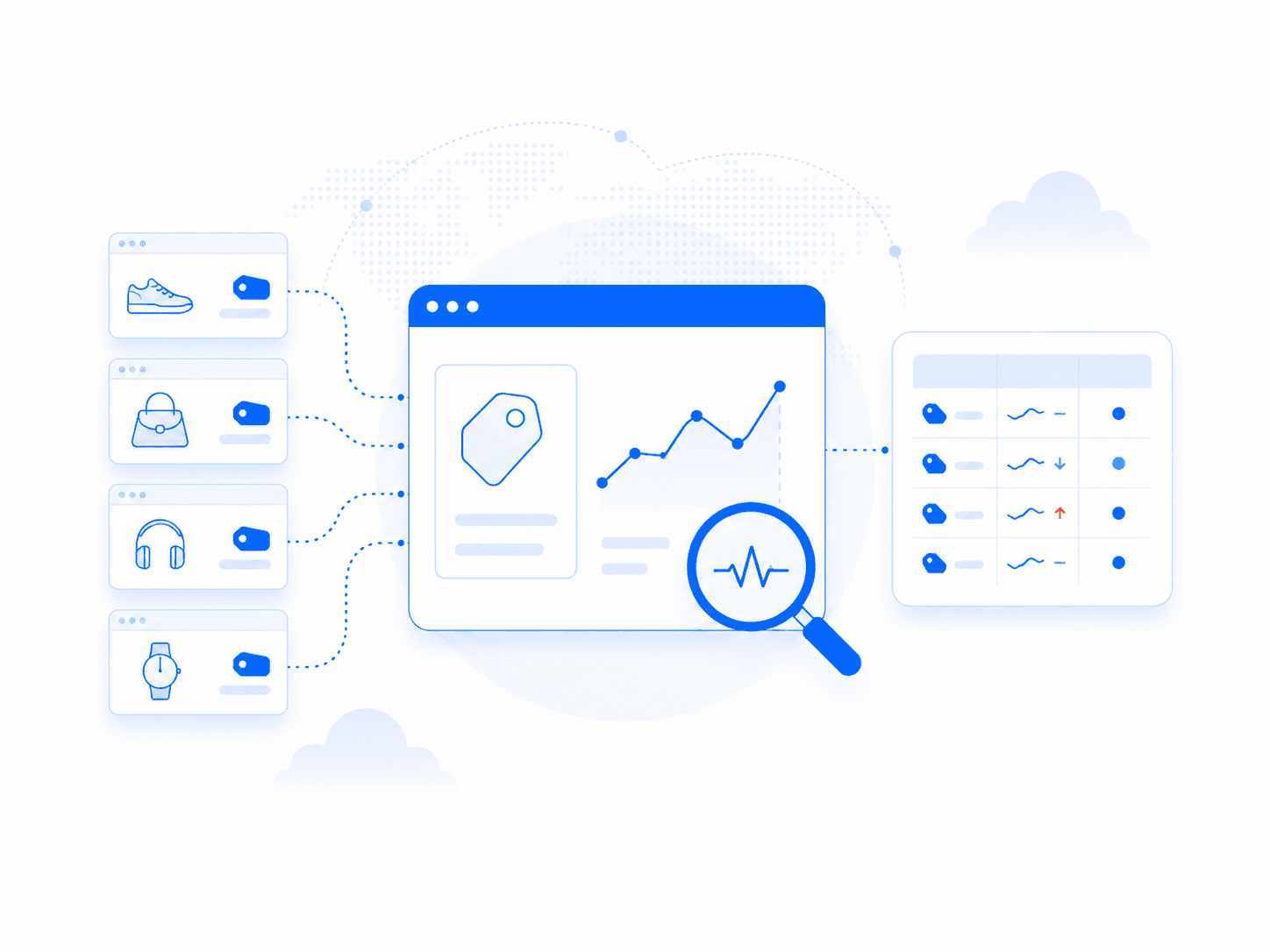
Price monitoring is the process of repeatedly checking public product pages, search results, category pages, and marketplaces to understand how prices move over time. Teams use it to watch competitor pricing, promotion timing, shipping fees, regional price differences, and stock-related price changes. For ecommerce SEO pages, this topic should clearly connect price monitoring proxies with public retail data collection, reliable recurring checks, and location-aware price visibility.
A price monitoring workflow usually combines several public signals from product and category pages.
Collect listed prices, sale prices, currency differences, and regional price variations.
Track coupons, campaign banners, member pricing, and limited-time retail promotions.
Compare price data with stock status, delivery estimates, and pickup options.
Store repeated checks to detect drops, increases, volatility, and pricing patterns.
Price monitoring often requires thousands of repeated requests across product pages, countries, and stores. Without proxies, checks can be rate-limited, personalized around one location, or blocked after a small number of requests. Proxies give teams a distributed network layer for ecommerce price scraping, regional price comparison, and recurring retail data collection.
Check how prices change by country, region, city, currency, and delivery market.
Run scheduled price checks without concentrating all traffic on one IP address.
Reduce biased results caused by repeated visits from the same server location.
Monitor large product lists, categories, and marketplaces in parallel.
Product pages, category pages, marketplaces, search pages, and local storefronts.
Residential or datacenter proxies distribute requests by location and session.
Normalized prices, discounts, stock context, and historical changes.
Most price monitoring workflows need a balance of location accuracy, stable sessions, and scalable request volume.
Residential proxies are the safest default for ecommerce price monitoring because requests appear closer to real shopper traffic. They are useful when retailers personalize prices, delivery options, or promotions based on location.
Use rotating sessions for broad catalog checks and sticky sessions when the workflow needs to keep a consistent cart, store, or location context.
Good for high-volume checks on public pages with low blocking and simple HTML.
Best forBest when price differences depend on ISP, ASN, city, or sensitive regional targeting.
Best forUseful for allowlisted tools, dashboards, and long-running price monitoring systems.
Best forE-commerce proxies are used for price monitoring, stock tracking, marketplace research, product page scraping, review monitoring, and competitor analysis. They help teams collect public retail data from different websites, locations, and marketplaces without sending every request from one IP address. This makes e-commerce data collection more stable at scale.
The best proxies for e-commerce price scraping are usually rotating residential proxies with country or city targeting. Retail websites often change prices, delivery options, taxes, and availability based on user location, so residential proxies help collect more realistic pricing data. Datacenter proxies can work on simple stores, but protected marketplaces often require stronger proxy quality.
Online stores may block price scraping when they detect too many requests from the same IP, unusual browser behavior, missing headers, or repeated access to product pages. Some retailers also use anti-bot systems to protect pricing data and prevent aggressive crawling. Proxies reduce IP-based blocking risk, but scraper behavior and browser fingerprint still matter.
Yes. Proxies can help monitor product availability, stock changes, sold-out items, and restocks across online stores and marketplaces. For high-volume tracking, rotating proxies distribute requests across multiple IP addresses and make repeated checks more stable. This is useful for retail analytics, inventory intelligence, and competitive monitoring.
Yes. Proxies are commonly used for marketplace scraping on public product listings, prices, seller pages, reviews, and category pages. Marketplaces often apply rate limits and regional content rules, so proxy location and rotation settings can affect data quality. Residential proxies are usually better for marketplaces with stronger protection.
Geo-targeted proxies help collect retail data from specific countries, regions, or cities. This matters because prices, shipping times, product availability, taxes, currency, and promotions can differ by location. For e-commerce intelligence, location-targeted proxies make it easier to compare markets accurately.
Residential proxies are usually better for retail scraping when the target website has anti-bot protection, location-based pricing, or strict rate limits. Datacenter proxies are faster and cheaper, but they are more likely to be flagged on protected retail websites. A practical setup often uses datacenter proxies for simple targets and residential proxies for sensitive marketplaces.
Yes. Proxies can help collect public customer reviews, ratings, product feedback, and marketplace comments from different locations. This data is useful for brand monitoring, sentiment analysis, product research, and competitor benchmarking. Proxies help keep review collection stable when websites limit repeated requests.
For large retail monitoring projects, rotating residential proxies with geo-targeting are usually the safest starting point. Sticky sessions may be useful for carts, multi-step browsing, or websites that require session continuity. The best setup depends on request volume, target websites, update frequency, and the level of anti-bot protection.
No. Proxies do not guarantee access to every online store or marketplace. Retail blocking can depend on IP quality, browser fingerprint, request speed, cookies, headers, JavaScript behavior, and account history. Proxies are one important part of an e-commerce data collection stack, but the scraper itself must also behave correctly.
Use proxies to collect public ecommerce prices from the right locations, at the right frequency, with fewer interruptions from rate limits and location bias.