
 Sign up
Suggest
Autocomplete suggestions
Collect search suggestions from seed keywords across languages and locations.
Collect keyword ideas, suggestions, and SERP context across locations and search engines.
Keyword research workflows collect public search suggestions, related queries, ranking pages, and SERP patterns. Proxies help SEO tools check different locations and languages while scaling keyword discovery beyond one visible IP address.
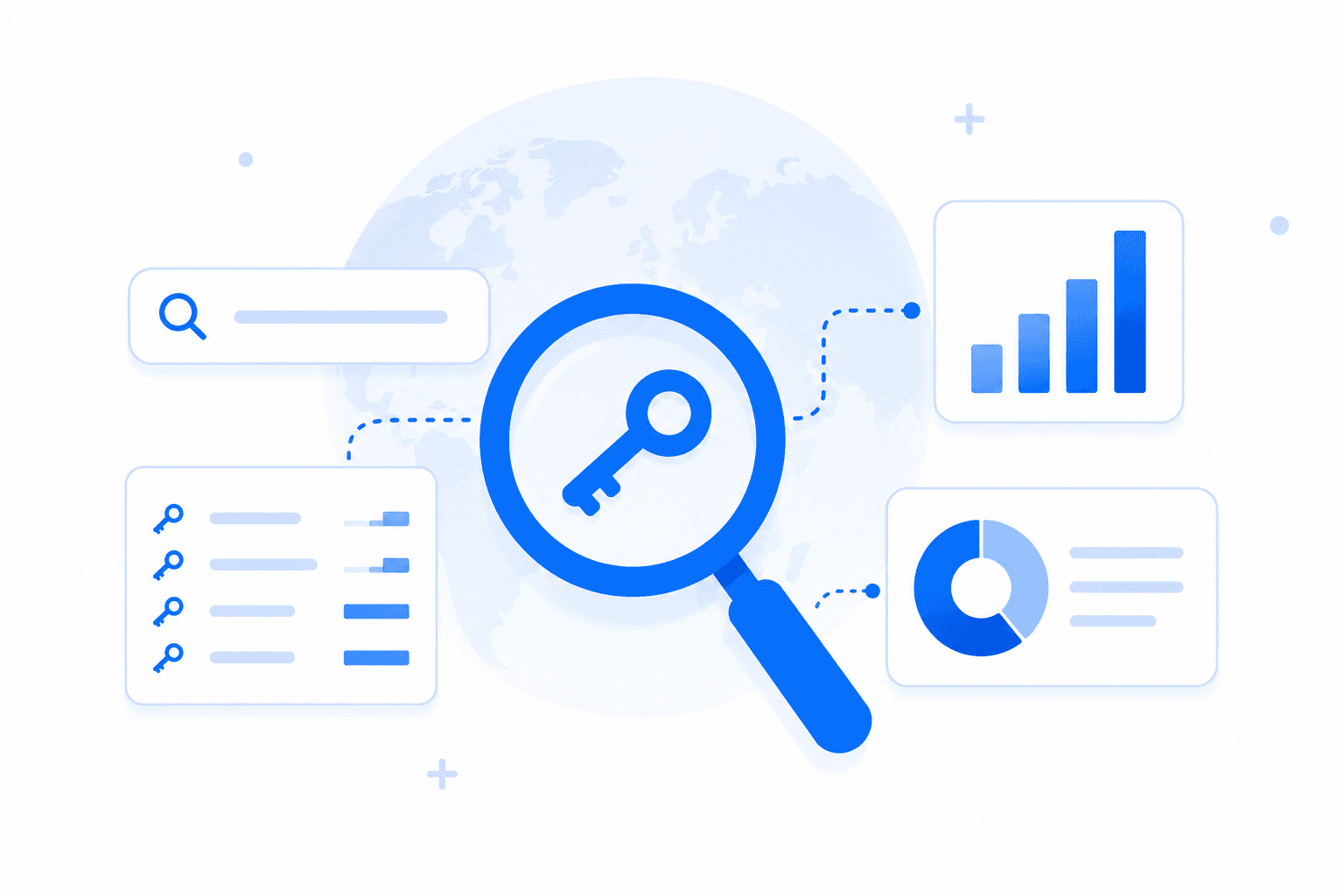
Keyword research data collection gathers public search signals that help SEO teams understand what people search for and how search engines interpret topics. It can include autocomplete suggestions, related searches, People Also Ask questions, top-ranking pages, SERP features, and regional differences. This page should target keyword research proxies, keyword scraping proxies, and search suggestion data collection.
Keyword research combines query expansion with search result context.
Collect search suggestions from seed keywords across languages and locations.
Find connected queries, entities, long-tail variants, and topic clusters.
Collect People Also Ask questions and informational query patterns.
Analyze top results, SERP features, competitors, and content formats.
Keyword suggestions and SERPs can change by country, language, device, and request pattern. Proxies allow keyword research tools to collect public search data from different markets, expand large seed lists in parallel, and avoid treating one server location as the only source of search intent.
Collect suggestions and related searches from specific countries and languages.
Scale keyword discovery across many seed terms and modifiers.
Validate keyword ideas against ranking pages and search features.
Distribute request volume instead of overusing one IP address.
Autocomplete, related searches, PAA, SERPs, and search modules.
Residential proxies route keyword checks through target locations.
Suggestions, questions, clusters, intent signals, and SERP context.
Keyword research needs broad coverage, language targeting, and enough scale for seed expansion.
Residential proxies are a practical default for keyword research because they support broad search data collection across countries, languages, and engines.
Use them when expanding seed terms, collecting public suggestions, and checking SERP context for many keyword groups.
Best for city-level keyword research and sensitive search sources.
Best forUseful for fast seed expansion on low-risk sources and internal experiments.
Best forUseful when mobile suggestions or mobile SERP layouts shape keyword strategy.
Best forSEO proxies are proxy servers used to collect search engine results, track keyword rankings, audit local SERPs, monitor competitors, and analyze search visibility from different locations. For SERP intelligence, proxies help SEO tools send queries through different IP addresses and locations, making it easier to collect search result data without relying on one blocked or rate-limited IP.
SEO tools need proxies for rank tracking because search engines may limit repeated queries from the same IP address. Proxies help distribute keyword checks across multiple IPs and locations, which is important for tracking rankings, snippets, local packs, ads, and organic results at scale. This is especially useful for agencies, SERP monitoring platforms, and in-house SEO teams.
The best proxies for Google search scraping are usually high-quality residential proxies with location targeting and controlled rotation. Google SERP data is sensitive to location, language, device context, and request behavior, so the proxy setup should match the SEO task. For simple keyword checks, datacenter proxies may work, but residential proxies are usually better for larger or more sensitive SERP scraping workloads.
Yes. Geo-targeted proxies help track local SEO rankings by letting you check search results from specific countries, regions, cities, or local markets. This is important because Google results can change significantly depending on user location. Local SEO proxies are useful for tracking map packs, local businesses, city-level rankings, regional ads, and localized search snippets.
Proxies improve SERP scraping accuracy by allowing SEO tools to collect search results from the right region and avoid relying on one IP address. Since SERPs are personalized and location-dependent, using the wrong IP can produce misleading ranking data. Geo-targeted proxies help SEO teams see search results closer to what real users see in specific locations.
Yes. Proxies can support competitor SEO research by helping collect public SERP data, competitor rankings, keyword positions, ad placements, and search result features from different markets. This allows teams to compare organic visibility, monitor content changes, and identify gaps in specific regions. The quality of the results depends on proxy location, query volume, and the SEO tool configuration.
Residential proxies are usually better for advanced SEO monitoring because they look closer to normal user traffic and can be geo-targeted more naturally. Datacenter proxies are often faster and cheaper, but they may be easier for search engines to rate-limit or block. For sensitive SERP scraping, keyword tracking, and local SEO intelligence, residential proxies are typically the safer choice.
Yes. Proxies can be used to check paid search ads, sponsored results, local ad visibility, and competitor ad placements in different regions. Since ad results can vary by country, city, language, and device context, geo-targeted proxies help advertisers verify how campaigns appear in target markets. This is useful for PPC audits, brand protection, and competitive ad monitoring.
For SEO and SERP scraping, rotating proxies are usually better for large keyword lists, while sticky sessions can be useful for workflows that require consistency. The best rotation setting depends on the number of keywords, target search engine, frequency of checks, and anti-bot sensitivity. A slower, more realistic query pattern usually performs better than aggressive scraping from the same IP.
No. SEO proxies help improve location accuracy and reduce IP-based limits, but they do not guarantee perfect ranking data. Search results can vary because of personalization, device type, language, cookies, search history, data center differences, and search engine experiments. For reliable SERP intelligence, proxies should be combined with clean query logic and consistent tracking methodology.
Use proxies to collect public keyword suggestions, related searches, questions, and SERP context across the markets your SEO strategy targets.